The oldest of the 5 blogs. The early ones, essays with photos were pretty good. Later ones not so great.
Monday, February 28, 2022


Thursday, February 24, 2022
Nothing since 2019?
That can't be right. The great ones since then must still be in the rear end of my head, waiting to bust out. I hope they don't all do it at the same time.
Monday, October 28, 2019
DANGEROUS DEEJAY DAYS
-------------------------------------------------------------------------------------------------------------------,
I was a radio deejay for almost 50 years. Here I go again, talking about radio. Before I got into radio at age 20, I grew up listening to shows like “Mr. District Attorney.” It ran for 14 years, starting in 1939. The comic book didn’t come along until 1948. There were a couple of movie versions and it was also on TV. But it all began on radio.


Walter Winchell invented the term Disc Jockey in 1935. You never heard of him? You are so young. Walter Winchell was a wildly popular and influential newspaper and radio news commentator and gossip columnist from the ‘30s into the ‘50s. His gossip about the stars got him punched by Al Jolson for something he wrote about Jolson’s wife, Ruby Keeler. Like lots of other radio stars, some later becoming famous in movies and TV, he had been a vaudeville performer. He knew how to give an audience what it wanted. If you are superannuated like me, you can still hear his unmistakable voice and shotgun delivery opening the show. “Good Evening Mr. and Mrs. North America and all the ships at sea. Let’s go to press!”
If you have the good fortune to own that issue of the Mr. District Attorney comic book, please tell me about the sinister gangland disc jockey. How sinister was he? How did they catch him? Any chance he got shot by a jealous husband? That happened at a station where I worked. Oh, the radio stories I could tell. But they must wait until my generation of record spinners has gone to that radio station in the sky._________________________________________________________________
BIG FAMOUS RADIO STARS

Sunday, October 13, 2019
2007
132 posts in 2007. I must go back and find out what I was so fired up about. I really like some of those early posts. A labor of love.
Saturday, January 05, 2019
New time old time.
Theater groups are producing live shows in old time radio style. Interesting. It's OK if they want to update for today's audience but I especially like those who have really studied the old shows and produced an authentic re-creation.
Sunday, October 15, 2017
Classic Fibber McGee
Don Quinn, who wrote the Fibber McGee and Molly radio show, came up with some lines that have become classics. "Don't open the hall closet," as everything tumbles out of it. And "Hello? Oh is that your Myrt " as Fibber asks the operator how's every little thing. "Tain't funny, McGee" from Molly when fibber does a dumb joke. "That an't the way I heeerd it" from the "Old timer" character, played by Bill Thompson. He was also Wallace Wimple who spoke of "My big old wife, Sweety Face."
Friday, August 04, 2017
Paladin's gun. Did he have a horse?
Paladin (Have gun will travel) is one of the radio shows I never watched when it went on TV. Was he some kind of cowboy on TV? No like that at all on radio. I listened to an episode last night that had lots of Chinese dialect that wouldn't fly at all today. Good radio though
Thursday, January 19, 2017
Lake Wobegon a satire?
Funny how we interpret things so differently. Somebody commented that Garrison Keillor's tales of the Town that Time Forgot were his satirical pokes at his provincial, fundamentalist upbringing in Minnesota. I heard them as a loving, funny tribute to those days. Probably because I come from a town that was a whole lot like Lake Wobegon and I treasure the memories.
Tuesday, November 22, 2016
Fun with Father. Brown, that is...
Oh those Brits know how to do TV. The Father Brown mysteries are a mix of good writing, casting and acting. I haven't read enough of Chesterton's original tales to know how TV compares. Nor have I got around to listening to the radio version. Will I see the TV characters when I listen?
Monday, March 28, 2016
The Girls in the Band
PBS ran a special about "The girls in the band." Great female pop musicians past and present. I caught only the last few minutes. I hope they had something about Phil Spitalny and his all girl orchestra. Who can forget Evelyn and her magic violin. Click on Phil.
Wednesday, January 20, 2016
RADIO JUST AIN'T WHAT IT USED TO BE
Old deejays never die. We just grumble about what happened to radio.
Sunday, September 06, 2015
When radio was all there was
I wonder if a person who grew up in the world of television and internet can ever fully appreciate the value of the spoken word as it was transmitted by radio in that medium's "golden era." A few podcasters try, but the word "radio" has a different feeling, a totally different meaning for them than it does for one who experienced radio when that's all there was.
Wednesday, August 26, 2015
VIC AND SADE
One more reason to be glad I'm pretty old: I listened to "Vic and Sade." It was one of the most popular radio shows back in the day. It wasn't a dramatic soap opera. Just Mr. and Mrs. Victor Gook (rhymes with book) and young son Rush talking about their daily lives and the colorful characters they knew. Nothing of great consequence, no drama. Brilliantly written with great humor, perfectly cast and performed, it was wildly popular and got lots of awards. The estimated number of listeners in 1943 was seven million. The Gooks lived in "the small house half-way up the next block." That's how the show started each day.
Looking back, thinking about what made it such a big hit, maybe you would need to have lived during the 30s and 40s to understand why we loved it. For escapism radio gave us the same fare we have on TV today. Soap operas, crime show, drama, sports, music and variety. But when we needed something we could relate to and laugh along with , Vic and Sade filled the bill. It was a sweet, simple time for a great many Americans. We really lived like that, sitting on the front porch and going over the day's events.
There are many old time radio fans not old enough to have experienced it as I did. I wonder what they have to say about Vic and Sade,
I am real pleased to find several online groups and blogs dedicated to Vic and Sade. This is my favorite: http://vicandsade.blogspot.com
Looking back, thinking about what made it such a big hit, maybe you would need to have lived during the 30s and 40s to understand why we loved it. For escapism radio gave us the same fare we have on TV today. Soap operas, crime show, drama, sports, music and variety. But when we needed something we could relate to and laugh along with , Vic and Sade filled the bill. It was a sweet, simple time for a great many Americans. We really lived like that, sitting on the front porch and going over the day's events.
There are many old time radio fans not old enough to have experienced it as I did. I wonder what they have to say about Vic and Sade,
I am real pleased to find several online groups and blogs dedicated to Vic and Sade. This is my favorite: http://vicandsade.blogspot.com
Wednesday, August 19, 2015

I have not listened to Garrison Keillor for quite a long time.
 Maybe it's that there are so many great story tellers on the internet and a few on live radio there isn't time to hear all of them.
 Canadian story teller Stuart McLean is apparently as popular on Canadian Radio and in public appearances as Keillor is in the states, maybe even more so. He's a good writer and his stories have more laugh-out-loud situations than Keillor's Lake
Wobegon monologues. Like Keillor's stories, McLean's Canadian tales have a standard cast of characters.
But I can't get used to his delivery. He reads his stuff and sounds like he's projecting to the live audience. Keillor knows how to romance a microphone and make it intimate. He is old enough to understand the power of radio as a spoken word medium.
To find the Canadian Show google "The Vinyl Cafe."
Radio, the once great spoken word medium

I did a Facebook post about how I liked Steve Allen, a true wit and multi talented performer. I said he's one of many TV greats who got their start in radio. Johnny Carson, too.
Ask anyone age 75 or younger about a favorite radio station and they'll say it plays good songs.
At 85, I have no common frame of reference with younger persons that lets me talk about radio as a great spoken word medium. They do podcasts and call it radio but it's not the real thing.
Tuesday, August 18, 2015
Vote for Gracie and the Surprise Party
The greatest presidential campaign was 1940. George Burns's beloved Gracie tossed her hat in the ring with real style.
Thursday, May 14, 2015
Radio's Big Voice
I imported this one from my Facebook Page
I listened to The Lone Ranger, The Challenge of the Yukon and Super Man last night. I continue to be amazed at how real those old radio shows were. Truly "theater of the mind." Another interesting thing. Male radio heroes had deep voices. Clark Kent went into the phone both , emerged as Superman and his voice dropped an octave . The rock culture and its falsetto singers changed all that. A deep voice now sounds like somebody's grandfather. I couldn't get used to the light voices of the movie actors who played Superman. They sounded like Clark Kent when he went into the phone booth to become Superman with super powers and a super voice. It just wasn't right. Another old time radio show, one of the best ever produced and also great onTV, was Gunsmoke. I never watched the TV version. William Conrad had the perfect Dodge City sheriff radio voice but he was too fat for TV. It was the longest running Western series.. I am so glad that I grew up with that kind of radio that let me draw my own mental pictures of what the characters looked like.
I listened to The Lone Ranger, The Challenge of the Yukon and Super Man last night. I continue to be amazed at how real those old radio shows were. Truly "theater of the mind." Another interesting thing. Male radio heroes had deep voices. Clark Kent went into the phone both , emerged as Superman and his voice dropped an octave . The rock culture and its falsetto singers changed all that. A deep voice now sounds like somebody's grandfather. I couldn't get used to the light voices of the movie actors who played Superman. They sounded like Clark Kent when he went into the phone booth to become Superman with super powers and a super voice. It just wasn't right. Another old time radio show, one of the best ever produced and also great onTV, was Gunsmoke. I never watched the TV version. William Conrad had the perfect Dodge City sheriff radio voice but he was too fat for TV. It was the longest running Western series.. I am so glad that I grew up with that kind of radio that let me draw my own mental pictures of what the characters looked like.
Saturday, March 14, 2015
NEW TIME RADIO
Podcasts are the New Radio. You see the "R" word used a lot in that way. It's audio, that's for sure. But it's not much like what has become Old Time Radio. There's lots of the old classic shows for younger persons who want to experience what their grandparents listened to or perhaps study it as history. But it's difficult to find a podcast or new radio drama that sounds like the "real thing," even those that are billed as produced in OTR style. The acting on contemporary audio theater is often pretty bad.
Podcast producers are so enamored with amazing digital special effects technology that they sometimes appear more interested in showing off their stuff with music and tightly edited clips than in communicating ideas or telling a story. Way back in the day, all you had to work with was a microphone, a live sound effects person and a Hammond organ for musical punctuation. Corny by today's standards but played by an expert, the Hammond was the perfect instrument for that purpose. Many early radio organists were true artists, having learned their craft accompanying silent films.
Alright, so I'm an old fart who grew up when radio was the biggest home entertainment and information medium. Thank you kindly for letting me pop off.
Podcast producers are so enamored with amazing digital special effects technology that they sometimes appear more interested in showing off their stuff with music and tightly edited clips than in communicating ideas or telling a story. Way back in the day, all you had to work with was a microphone, a live sound effects person and a Hammond organ for musical punctuation. Corny by today's standards but played by an expert, the Hammond was the perfect instrument for that purpose. Many early radio organists were true artists, having learned their craft accompanying silent films.
Alright, so I'm an old fart who grew up when radio was the biggest home entertainment and information medium. Thank you kindly for letting me pop off.
Monday, August 11, 2014
MICHAEL AND ME
The Michael in the title is Michael Moore. OK, so I don't know him and all we share is a Flint, Michigan
 connection. Pretty important for both of us. It can't hurt to toss out the name of somebody famous. Michael got famous for "Roger and Me, " his film about General Motors' part in the near death of that once great city.
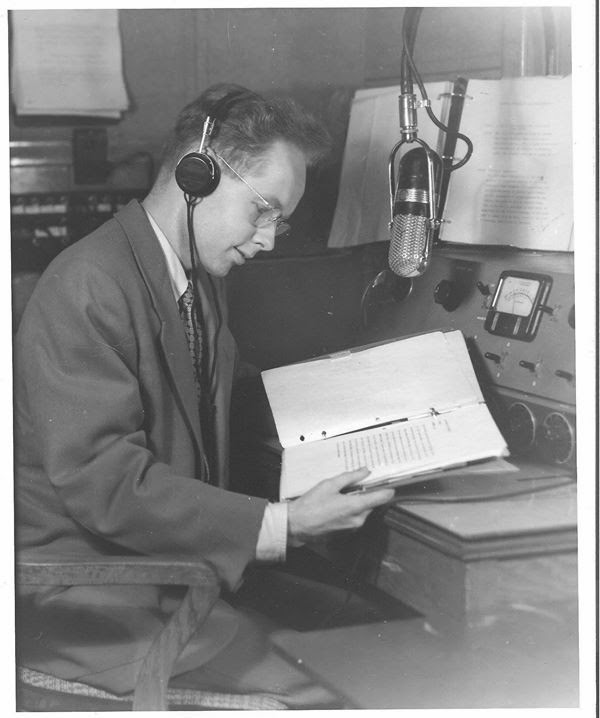
I got famous in Flint ... alright maybe not that famous... as a hotshot deejay in Flint Radio. That was 1950. Was I cute, or what? Another famous Flint name is William "Billy" Durant. He founded General Motors in 1908. There was a Durant Hotel. I don't know if it's still there. And a Durant auto, too.
Flint was still a big prosperous GM town when I was there. That's where I met my wife, a radio fan and our first child was born there. Relatives and in-laws worked at the auto plants. I would not have met my wife but for the great migration of Southerners who came North for good factory jobs.
I'm not a great fiction reader but I'm glad my wife was a John Grisham fan. I took a look at her copy of his 2001 novel, "A Painted House." It was a tale of an Arkansas family and their trek to Flint for work. My wife was born in Newport, Arkansas and they moved to the Flint area when she was three years old. When somebody mentions John Grisham I always ask if they read that one.
 My wife, young son and I left Flint in 1954, the year that Michael Moore was born, in my big beautiful white 1951 Dynaflow Special just like this one. Actually, the "Special" was the low end Buick model. But I felt like I was driving a Roadmaster when that Dynaflow transmission wound up and she started to move. We listened to Gisele MacKenzie sing "My Buick, my love and I," the theme song of "Uncle Miltie" Milton Berle's TV show. Chevrolets went by, families hearing Dinah Shore's theme music, "See the USA in your Chevrolet." It was still a good time for Flint and General Motors and it got even better into the 60s. One of the several radio jobs that I left, not exactly voluntarily, was at WTAC. That stood for "The Auto City." A sign at the North end welcomed all to "Buick Town." A few years ago a long mothballed arch was dug out and re-erected over Saginaw Street. It originally proclaimed Flint "TheVehicle City."
 By the time native son Michael Moore grew up, his town had fallen on terrible times. GM closed most local plants and moved to Mexico. Moore's documentary, "Roger and me" showed him demanding to see GM CEO Roger Smith to give him an earful about what he had done to Flint. Someone painted the sign when Flint was named one of the country's five most dangerous cities.
 What got my nostalgia juices flowing about all this history is a 1923 Durant that showed up in the Muskegon shop of friend Phil Schugars, a professional restorer of classic and antique cars. It's owned by Ken Brink, a member of the Durant owners club. His e-mail address even makes reference to the Durant name.
 Durant's company built other cars including the Flint. Here's a classy 1925 Flint Touring Car. Wouldn't it have been the cat's meow to take your best girl for a ride in this baby! Or the whole family.
The first words I spoke into a radio microphone were "Going Forward With Flint." It hasn't worked out well for Flint or the Buick. She wasn't even 10 years old when the junkyard gave me twelve bucks for her. Oh well, I have great memories. I won't forget the town where my son and my Buick were born.
I got famous in Flint ... alright maybe not that famous... as a hotshot deejay in Flint Radio. That was 1950. Was I cute, or what? Another famous Flint name is William "Billy" Durant. He founded General Motors in 1908. There was a Durant Hotel. I don't know if it's still there. And a Durant auto, too.
Flint was still a big prosperous GM town when I was there. That's where I met my wife, a radio fan and our first child was born there. Relatives and in-laws worked at the auto plants. I would not have met my wife but for the great migration of Southerners who came North for good factory jobs.
I'm not a great fiction reader but I'm glad my wife was a John Grisham fan. I took a look at her copy of his 2001 novel, "A Painted House." It was a tale of an Arkansas family and their trek to Flint for work. My wife was born in Newport, Arkansas and they moved to the Flint area when she was three years old. When somebody mentions John Grisham I always ask if they read that one.
My wife, young son and I left Flint in 1954, the year that Michael Moore was born, in my big beautiful white 1951 Dynaflow Special just like this one. Actually, the "Special" was the low end Buick model. But I felt like I was driving a Roadmaster when that Dynaflow transmission wound up and she started to move. We listened to Gisele MacKenzie sing "My Buick, my love and I," the theme song of "Uncle Miltie" Milton Berle's TV show. Chevrolets went by, families hearing Dinah Shore's theme music, "See the USA in your Chevrolet." It was still a good time for Flint and General Motors and it got even better into the 60s. One of the several radio jobs that I left, not exactly voluntarily, was at WTAC. That stood for "The Auto City." A sign at the North end welcomed all to "Buick Town." A few years ago a long mothballed arch was dug out and re-erected over Saginaw Street. It originally proclaimed Flint "TheVehicle City."By the time native son Michael Moore grew up, his town had fallen on terrible times. GM closed most local plants and moved to Mexico. Moore's documentary, "Roger and me" showed him demanding to see GM CEO Roger Smith to give him an earful about what he had done to Flint. Someone painted the sign when Flint was named one of the country's five most dangerous cities. What got my nostalgia juices flowing about all this history is a 1923 Durant that showed up in the Muskegon shop of friend Phil Schugars, a professional restorer of classic and antique cars. It's owned by Ken Brink, a member of the Durant owners club. His e-mail address even makes reference to the Durant name. Durant's company built other cars including the Flint. Here's a classy 1925 Flint Touring Car. Wouldn't it have been the cat's meow to take your best girl for a ride in this baby! Or the whole family. The first words I spoke into a radio microphone were "Going Forward With Flint." It hasn't worked out well for Flint or the Buick. She wasn't even 10 years old when the junkyard gave me twelve bucks for her. Oh well, I have great memories. I won't forget the town where my son and my Buick were born.
Subscribe to:
Posts (Atom)